University of Kentucky College and Career Studies Program Celebrates Students
The Human Development Institute at the University of Kentucky recognized the following Kentucky Supported Higher Education Partnership (KSHEP) students for their achievements in a ceremony on May 2, 2024:
Completion of College and Career Studies program at the University of Kentucky
Sara Jones (primary focus on Universal Design, Animal Care and Support, and Storytelling in Literature).
Justin Harmon (primary focus on Universal Design, Theatre Arts, and Advocacy and Inclusion). Completion of Undergraduate Certificate in Universal Design
Callie Baesler
Kate Boudreaux
Will Lyon
Sara Jones
Justin Harmon
Spotlight on new CCS alums:
Justin Harmon
The College and Career Studies (CCS) program at the University of Kentucky helped me achieve my dream of going to college.
I am thankful for the opportunity it gave me to attend many interesting classes, learn new things, make new friends, and experience campus life. I will forever be grateful for my time as a CCS student at UK, and will always be proud to call myself an official Wildcat!
Justin Harmon, CCS alum
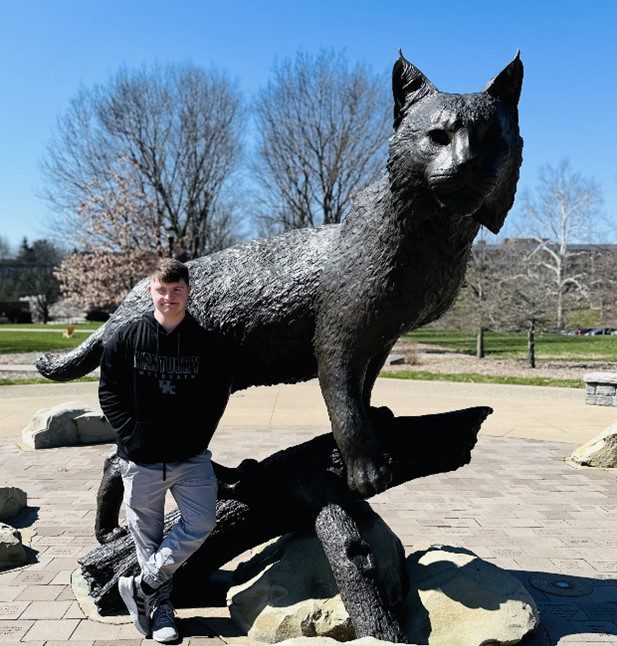
Justin in front of UK Wildcat statue
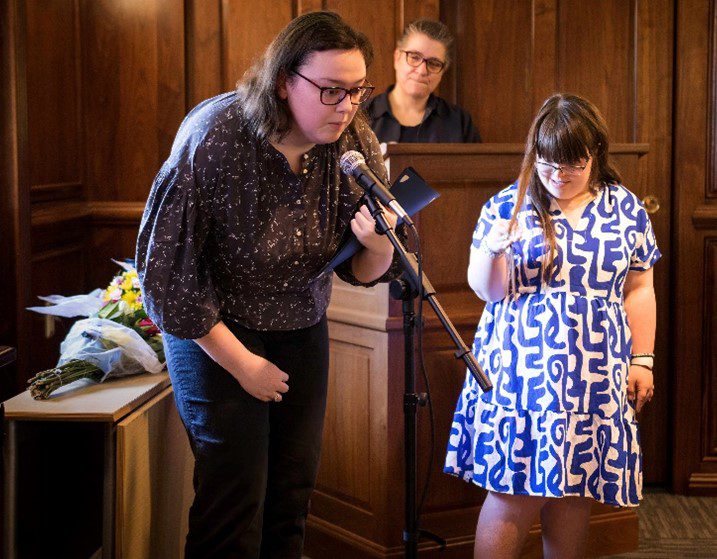
Sara Jones (left), Ann Switzer (right), and Erin Fitzgerald (background)
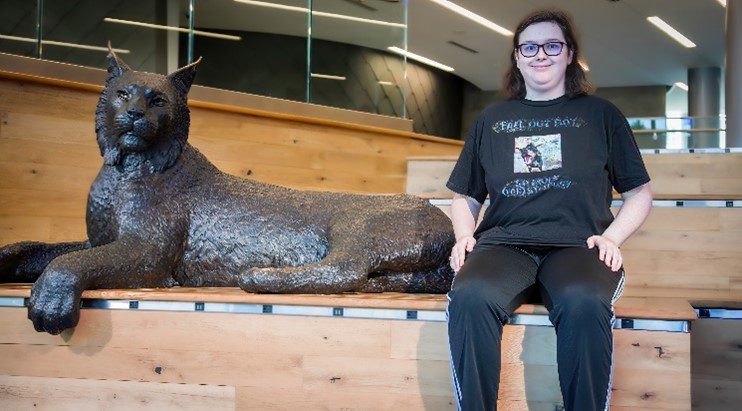
Sara sitting with UK Wildcat statue
Sara Jones
Things I learned in college:
I learned ways to communicate effectively with others.
I can use what I have learned about Universal Design and Universal Design for Learning in many environments.
I learned that I am most interested in caring for and supporting animals when thinking about a future career.
I learned to be an advocate for myself and others for resources to be inclusive and accessible to everyone.
I learned that I can overcome challenges that come with being a neurodivergent person.
I learned that I can be successful.
Sara Jones, CCS Alum
Thanks to everyone who made the 2023/2024 academic year a success! Congrats to all the students who completed a milestone this year, and also to students who completed their first year. We can’t wait to see what you all do next!
Western Kentucky University’s application to the US Dept of Ed to establish a CTP has been approved. WKU’s program is the 6th Comprehensive Transition Program that has been approved in the Commonwealth.
Through multiple projects and initiatives over the last 20 years, Kentucky has demonstrated a strong commitment to supporting students with intellectual and developmental disabilities in postsecondary education. The timeline below highlights some of this work.
2005
Postsecondary Opportunities Workgroup (POW) is launched by families, young adults with intellectual disabilities, and Kentucky organizations.
2008
Postsecondary Inclusion Partnership PIP begins a three-year grant funded by the Commonwealth Council on Developmental Disabilities.
2010
The University of Kentucky Human Development Institute is awarded a five-year $2.1 million federal grant Supported Higher Education Project, SHEP.
2011
A pilot between SHEP and the Office of Vocational Rehabilitation provides support services on college campuses around Kentucky.
2012
SHEP staff and students with intellectual disabilities present to the Kentucky Legislative Subcommittee on Postsecondary Education.
A group from Murray State University, led by a parent advocate, expresses interest in starting a program on campus.
Representative Carl Rollins attends the POW meeting and hears concerns that SHEP students cannot utilize Kentucky Educational Excellence Scholarship Program money.
2013
Kentucky’s first U.S. Department of Education approved Comprehensive Transition and Postsecondary (CTP) program was established at Murray State University.
Kentucky Legislature unanimously passes a bill to allow students with alternate diplomas to access their KEES money.
2014
Bluegrass Community & Technical College Comprehensive Transition Program (CTP) program approved.
SHEP, POW, and stakeholders explore expansion and sustainability options.
Spalding University Comprehensive Transition Program (CTP) program approved.
2015
Northern Kentucky University Comprehensive Transition Program (CTP) program approved.
2016
Partnerships in Employment State Systems Change grant.
Legislative action to increase KEES funding available to students with intellectual disabilities enrolled in Kentucky CTP programs.
2019
Inclusive Higher Education Webinar series.
2020
Kentucky State Budget addresses Supported Higher Education.
2021
Kentucky Supported Higher Education Partnership.
2022
University of Kentucky Comprehensive Transition Program (CTP) program approved.
Legislative action expands the Work Ready Kentucky Scholarship to include students with ID enrolled in Kentucky CTP programs.
2023
Owensboro Community and Technical College Comprehensive Transition Program (CTP) program approved.
2024
Western Kentucky University Comprehensive Transition program approved.
Kentucky Comprehensive Transition and Postsecondary Programs for Students with Intellectual Disabilities
Program Brief for Potential CTPs
Comprehensive Transition & Postsecondary Programs
Comprehensive Transition and Postsecondary Programs (CTPs) were created by the Higher Education Opportunities Act (HEOA, 2008) and are designed to support students with intellectual disabilities (ID) who want to continue academic, career and technical, and independent living instruction at an institution of higher education (IHE) in order to prepare for employment.
CTPs are higher education programs for individuals with ID that lead to a meaningful credential. Hallmarks of high-quality programs include (a) the social and academic integration of students with ID with their non-disabled peers, and (b) an individualized person-centered planning process that improves the needed skills and competencies of each student.
A high-quality CTP increases the number of individuals with ID who are academically, practically, and socially prepared to obtain and retain competitive employment in integrated settings and prepares them to live full and independent lives.
What does it mean for students?
Eligible students with ID, as defined by the HEOA, who are enrolled in an approved CTP will have the opportunity to take challenging and meaningful credit and non-credit courses alongside their non-disabled peers and in their chosen fields of study.
Additionally, students enrolled in an approved CTP are eligible for federal and state financial assistance – even if they don’t have a regular high school diploma and are not matriculating toward a degree.
Student Financial Assistance:
Students with ID enrolled in an approved CTP can access federal financial aid for which they qualify and state financial aid from the Kentucky Educational Excellence Scholarship (KEES), Work Ready Kentucky Scholarship, and College Access Program Grant programs, if eligible. Students and families can contact the Kentucky Higher Education Assistance Authority (KHEAA) at (800) 928-8926 or visit kheaa.com for help with the financial aid process.
IHEs interested in establishing a CTP must apply to the Federal Student Aid Office at the United States Department of Education (ED). The establishment of an approved CTP enables IHEs to:
Provide access to financial aid for students with ID
Receive recognition as an approved CTP on the ED website
Promote equitable access and success for a population of students conspicuously underrepresented in higher education
ThinkCollege, the National Coordinating Center for Transition Postsecondary Programs for Students with ID, has developed a learning module on CTPs. This four-part module discusses requirements for CTPs, preparing to become a CTP, the application submission and review process, and other components to student financial aid eligibility. The module includes a CTP Application Template, a step-by-step checklist, key components from successful CTP applications, as well as other related resources.
Promoting access to quality inclusive postsecondary education for students with intellectual and developmental disabilities through a shared focus on collaboration through program development, resources, research, and public policy in Alabama, Arkansas, Georgia, Florida, Kentucky, Louisiana, Mississippi, Tennessee, North Carolina, South Carolina & beyond!