In Kentucky, 19% of students with disabilities, across disability categories, enrolled in a college or university in the year following their exit from high school. For students with an intellectual disability, it was 9%. (2024 Kentucky Post School Outcomes Center)
The Kentucky Supported Higher Education Partnership (KSHEP) is a network of Institutions of Higher Education across the state offering higher education programs for students with intellectual and developmental disabilities, such as CTP programs.
Before 2020, when the Kentucky General Assembly started investing dollars for programslike CTPs, Kentucky had only 3 U.S. Department of Education approved CTP programs. Since 2020, Kentucky has doubled its number of CTPs.
Application & Enrollment
164 Applicants
48% Enrolled
52% Not Enrolled
Paid Employment
78% of students had paid employment during or at completion of the program
Program Completion
36 students have completed their program since 2020
What programs are saying…
“Thanks to funding from the KY General Assembly, students in the University of Kentucky’s College and Career Studies program reported many positive experiences, such as continuing theirstudies after high school, exploring career andcommunity opportunities, learning about autonomy and advocacy, and finding and maintaining meaningful social connections.”
“Through SHEP funding, Murray State’s College to Career Experience program provides a higher education experience for students withintellectual disabilities focused on building skills to improve employment options.”
“The students in this [BCTC’s Comprehensive Transition and Post-Secondary Program]program are hardworking, loyal and laser focused on gaining skills for today’s workforce. I couldn’t imagine a better set of workers for Kentucky!”
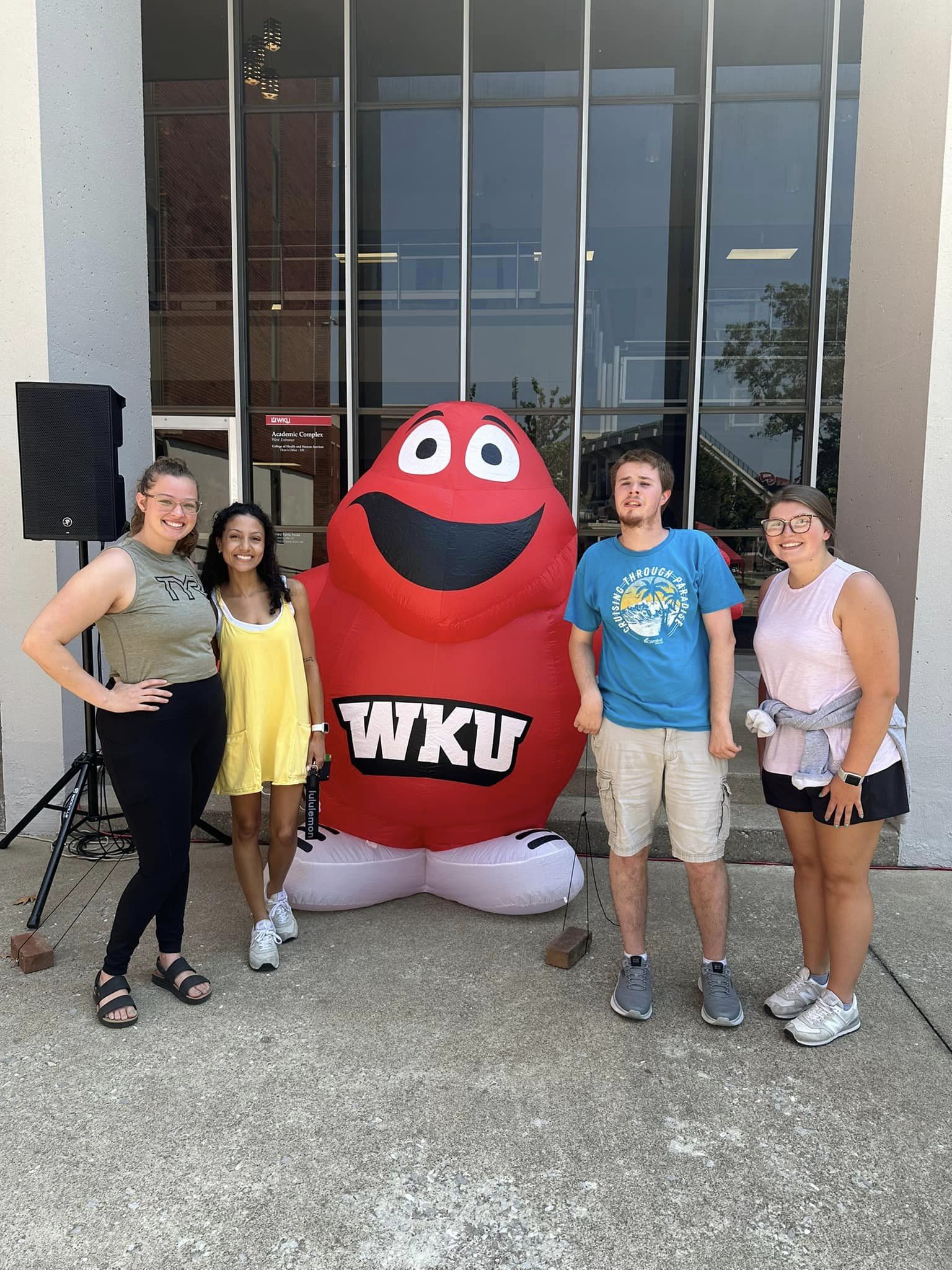
“Funding for CTP programs, like the SAV-Y program at WKU provides life-changing opportunities for students with intellectual and developmental disabilities by helping them gain the skills, confidence, and independence needed for meaningful employmentand community inclusion.”
“The funding we receive completely sustains and supports NKU’s SHEP Program. It allow students with intellectual and developmental disabilities to pursue a college experience which gives them opportunities to develop the skills and strengths needed for future employment.”
“Funding is vital for the continuation of our Career and Life Skills Program at Owensboro Community and Technical College. This program opens doors for students with intellectual disabilities to attend college, build independence, and pursue meaningful careers.”
The Supported Higher Education Partnership at the University of Kentucky Human Development Institute is funded as the Supported Higher Education Project in the State Executive Branch Budget (July 1, 2024 – June 30, 2026) at $500,000 in each year of the biennium.
The Kentucky Supported Higher Education Partnership (KSHEP↗) is a network of Institutions of Higher Education (IHEs) across Kentucky. These IHEs provide higher education programs for students with intellectual and developmental disabilities, such as Comprehensive Transition and Postsecondary (CTP) Programs. CTP programs are designed to support students with intellectual disabilities (ID) who wish to continue their academic or career and technical instruction at an IHE to better prepare for competitive integrated employment (CIE)↗ and independent living.
Currently, KSHEP consists of six U.S. Department of Education approved CTP programs: Bluegrass Community & Technical College, Murray State University, Northern Kentucky University, Owensboro Community & Technical College, University of Kentucky and Western Kentucky University. The University of Kentucky Human Development Institute serves as the statewide technical assistance center for KSHEP.
This report presents data collected for the Fall 2024- Spring 2025 academic year from each of the six participating IHEs. Data was gathered through online surveys completed by CTP Coordinators at each participating school.
Program Data Summary
The tables below present data collected from participating IHEs during the Fall 2024 and Spring 2025 academic semesters. This includes information on program structure, student enrollment, internships, employment outcomes, and the number of students who completed their CTP program. Together, these data points offer a snapshot of student engagement, program reach, and areas for continued growth across IHEs.
Program Hours and Credential Type
Table 1 provides an overview of the full program length and credential type offered by each participating IHE. The number of program hours reflects the total hours required to complete the program, while the credential type indicates the formal recognition awarded upon completion.
Table 1. Number of Program Hours and Credential Type
Institution of Higher Education
# of Program Hours
Type of Credential
Bluegrass Community & Technical College
24
Certificate
Murray State University
24
Certificate
Northern Kentucky University
36
Certificate
Owensboro Community & Technical College
19–25
Certificate
University of Kentucky
24
Certificate
Western Kentucky University
36
Certificate
Internships
CTP Coordinators reported on students participating in unpaid internships (including practicums and career exploration services) and the number of students who had paid internships during the Fall 2024 and Spring 2025 semesters (See Tables 4 and 5).
Table 4. Number of Students with Paid or Unpaid Internships during the Fall 2024 Semester
Institution of Higher Education
# Unpaid Internships Fall 2024
# Paid Internships Fall 2024
Bluegrass Community & Technical College
–
–
Murray State University
–
–
Owensboro Community and Technical College
–
–
Northern Kentucky University
3
4
University of Kentucky
1
1
Western Kentucky University
–
–
Grand Total
4
5
Table 5. Number of Students with Paid or Unpaid Internships during the Spring 2025 Semester
Institution of Higher Education
# Unpaid Internships Spring 2025
# Paid Internships Spring 2025
Bluegrass Community & Technical College
7
1
Murray State University
–
2
Owensboro Community and Technical College
7
–
Northern Kentucky University
5
4
University of Kentucky
6
2
Western Kentucky University
–
–
Grand Total
25
9
Employment
CTP Coordinators provided data on the number of students with paid employment during the Fall 2024 and Spring 2025 semesters. Paid employment refers to earning wages for work performed in any setting, whether or not it meets the definition of CIE. Employment may have started before the semester and continued after it (See Tables 6 and 7).
Table 6. Number of Students with Paid Employment during the Fall 2024 Semester
Institution of Higher Education
# With Paid Employment
Bluegrass Community & Technical College
–
Murray State University
–
Owensboro Community and Technical College
4
Northern Kentucky University
4
University of Kentucky
4
Western Kentucky University
–
Grand Total
12
Table 7. Number of Students with Paid Employment during the Spring 2025 Semester
Institution of Higher Education
# With Paid Employment
Bluegrass Community & Technical College
1
Murray State University
1
Owensboro Community and Technical College
2
Northern Kentucky University
2
University of Kentucky
4
Western Kentucky University
–
Grand Total
10
Program Graduates and Competitive Integrated Employment (CIE)
CTP Coordinators reported on the total number of students who completed the program at the conclusion of the Spring 2025 semester (See Table 8). Note: no students completed the program during the Fall 2024 semester.
Table 8. Number of Students with Paid or Unpaid Internships during the Spring 2025 Semester
Institution of Higher Education
# Who Completed the Program
# With CIE
Bluegrass Community & Technical College
–
–
Murray State University
–
–
Owensboro Community and Technical College
2
–
Northern Kentucky University
2
2
University of Kentucky
5
3
Western Kentucky University
–
Grant Total
9
5
Qualitative Insights
CTP Coordinators reported on major activities, successes, and challenges during the Fall 2024 and Spring 2025 semesters. From their statements, clear themes emerged across the academic year and are summarized below. There are a few highlights specifically for the Spring semester which are noted separately.
Major Accomplishments
Academic Engagement & Projects
Students expanded their academic skills and confidence through coursework tailored to their interests, along with projects that allowed them to apply learning in creative and practical ways.
Schools reported that coursework, including core classes, individualized classes, and expansion of course loads, led to increased engagement.
Schools noted that students completed projects in areas such as writing, media, arts, sports journalism, photography, healthcare, graphic medicine, mentorship, and universal design.
Career Development & Readiness
The CTP programs connected academics to career pathways by offering opportunities for skill-building, exploration, and hands-on experiences.
Multiple schools reported having weekly career development sessions focused on employment topics and job readiness skills.
Schools reported that throughout the academic year students participated in internships, volunteer roles, and career fairs to practice networking and explore career options.
It was noted by schools that peer mentors provided support during events and projects, reinforcing skill development.
Campus & Social Engagement
Campus involvement fostered social growth, independence, and a stronger sense of belonging.
Most schools reported that students attended campus events, social gatherings, and program activities such as rodeos, disco day, and other student-led events.
It was noted that many students demonstrated greater comfort navigating campus independently, using services, and participating in clubs and activities.
Schools reported that peer mentors provided academic and social support, helping students integrate into the college environment.
Residential Living & Independence
Living on campus offered students immersive opportunities to practice independence and daily living skills. Currently there is one school that offers residential housing options on campus, and it reported:
Expanded housing options increased access to residential life.
Over half of students in the program lived on campus, enhancing social engagement and daily living skills; the highest to date.
Staff and housing partnerships strengthened supports for independent living.
Student Support & Person-Centered Planning
Individualized supports helped students set goals, reflect on progress, and identify next steps for growth.
Multiple schools reported having Person-Centered Planning meetings with students and their families for class planning, internship exploration, and identifying support needed.
Schools noted that supports were tailored to encourage academic, career, and personal growth for both new and returning students.
Leadership, Recognition, & Community Engagement
Students gained confidence as leaders while programs were recognized for their contributions at institutional and community levels.
Students presented their experiences, organized events, and practiced self-advocacy.
Schools received recognition; for example, Bluegrass Community & Technical College (BCTC) received the President’s Award from BCTC.
Staff participated in professional collaboration at roundtables and conferences.
One school held a Career and Life Open House recruiting event to share the CTP program with community organizations and prospective students and families.
Recruitment, Admissions, & Program Growth
Programs demonstrated stability while preparing for future expansion and sustainability.
Recruitment efforts generated strong interest, with competitive admissions processes for limited spots.
Students progressed at different stages: some entered the program, others advanced to their second semester, some completed certificates and graduated, while others left for personal reasons.
Staffing transitions were managed smoothly, ensuring continuity for the students.
Media collaborations, including student-produced videos↗, raised visibility of the program at multiple schools.
Successes
Program Growth & Visibility
The CTP Program continued to expand and strengthen, showing steady progress across campuses and growing student interest.
Expanded outreach across schools led to strong student interest and applications, with some students waitlisted or turned down due to program capacity.
CTP gained visibility through their school’s media team, conferences, and institutional rewards including the President’s Award.
Academic Engagement & Success
Students developed confidence and skills through coursework, individualized learning supports, and faculty collaboration.
Across the board, schools reported students completed challenging academic courses with increased student success.
Multiple schools reported student projects across writing, media, arts, healthcare, and design, connecting classroom learning to creative expression and problem-solving.
Career Development & Readiness
Students gained practical skills and explored varied employment paths.
Schools noted that students participated in internships, volunteer opportunities, and community career fairs to explore job options.
Multiple schools reported individualized supports in resume writing, interviewing, and job search preparation.
One school reported that a few students pursued technical courses outside the regular program pathway, such as carpentry, welding, and data entry operator.
Independent Living & Campus Integration
Students demonstrated growth in navigating campus, daily living and social participation.
One school reported expanded on-campus housing with staff supports and strengthened partnerships.
Students gained skills in transportation, daily living, self-management, and community engagement.
Peer, Family, & Community Support
Connections with mentors, families, and staff reinforced student learning and engagement.
Schools reported peer mentors provided academic, social, and career-related guidance.
Schools reported that families stayed engaged through newsletters, planning meetings, and events to support student progress.
Community partnerships expanded opportunities for experiential learning and student participation, as noted by the schools.
Leadership, Engagement, & Student Voice
Students took on leadership roles and strengthened self-advocacy.
Students presented on college experiences, led activities, organized campus events, and contributed to enhancing student engagement.
Schools reported student growth in confidence, leadership, and community involvement.
Special Spring 2025 Highlights
CTP Coordinators and students celebrated key achievements.
Certificate completions and program graduations occurred across multiple schools.
Western Kentucky University completed its first full year as a CTP.
At The University of Kentucky, five students earned an undergraduate certificate in Universal Design.
Challenges
Student Transition & Adjustment
Some students experienced challenges adapting to the expectations and responsibilities of college life.
A couple of schools reported that some students struggled with self-discipline, time management, and understanding the impact of academic choices.
Transportation barriers limited access to supports (e.g., tutoring, etc.) as reported by one school.
Staffing, Peer Mentorship, & Support Capacity
Schools faced difficulty recruiting, training, and retaining enough staff and peer mentors to meet student needs.
Persistent shortages of peer mentors placed pressure on staff to fill gaps in support across multiple schools; at times limiting direct support availability for students.
Many schools reported difficulty recruiting, training, and retaining peer mentors, highlighting the need for creative approaches and sustainable partnerships (e.g., with retired educators).
Multiple schools reported that limited staffing sometimes made it difficult to provide the level of individualized, in-person support students required.
Practicum, Internships, & Experiential Learning
Securing appropriate work-based learning opportunities remained a challenge across schools including:
There was difficulty identifying practicums that aligned with student interests and available resources.
Limited placements affected the ability to connect students with meaningful work-based learning.
Financial Barriers
Affordability challenges limited access for some students, particularly those from out-of-state.
Families faced restricted access to financial aid, increasing the burden of program participation.
These barriers highlighted the importance of exploring additional options to support broader access at each school.
Program Development & Growth
As the CTP program expanded at each school, they experienced growing pains in developing systems, strengthening structures, and increasing visibility, including:
Continued need to increase visibility of the CTP program with community partners.
Collaboration between faculty and staff improved, helping to address student needs, but remains an area to strengthen further.
Advancing Program Integration within the Institution
CTP Coordinators were asked how program staff advanced or sought to advance efforts to embed their program with the mission, vision, and work of their institution. Below are their Spring 2025 unedited statements.
Bluegrass Community & Technical College (BCTC): I have collaborated with our tutoring department to use their tutoring training modules to help with onboarding new mentors. They are also going to count out mentoring hours toward the college totals. I have collaborated with the student accessibility support office in helping with their club and with proctoring exams. They have been so supportive with accommodations and are a new staff. This has been a great way to build supportive relationships.
Our program was featured in the Provost Post for the Madison County trip and for hiring our graduate to be a mentor. One student is working toward an associate’s degree and he mentored 385 hours over the past year. He volunteered another 30 hours in May 2025. Our program was given the Presidential Award that was personally selected by Dr. Feeney. Wow, that was such an honor! They even mentioned this is a department of 1 full time person. It was a great moment to celebrate the program and to remind our college to be include all students.
Murray State University (MSU): This semester CCE worked with different departments and higher leveled classes. One student took ART 382 which is Intro to Photography. Although this is a higher-level class our students are able to take this and thrive in it. The professor was very nice and accommodating to our student.
Northern Kentucky University (NKU): We provide content/updates with various departments and partners on campus in order to share some of the exciting things that take place within SHEP. These individuals often times are able to help us share this information through their social media platforms in order for more students/staff/faculty to stay connected to and aware of SHEP. We reach out to new departments on campus in order to advance the SHEP Program and help staff and faculty become more aware of our presence and mission on campus. This also helps us create new internships placements for students.
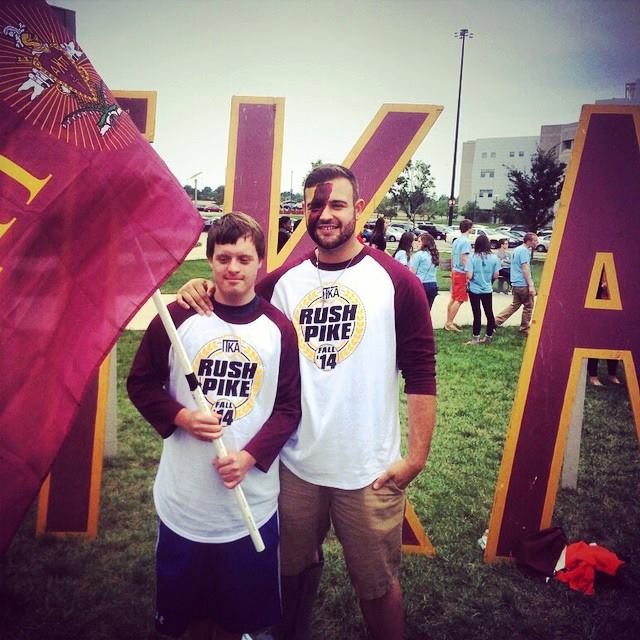
With NKU’s mission in mind, we are always trying to remove obstacles that prevent SHEP students from being fully included in the college life experience, whether that be academically or socially. At times, this has looked like advocating for the student and identifying the reasons why they should be able to register for a class of their choosing when there is initial push back from the faculty. Or helping students get involved in activities such as Greek life that may have certain requirements or criteria.
Owensboro Community & Technical College (OCTC): Collaboration with Career Services department Implementing a campus-wide event for all students on campus to foster belonging among students.
University of Kentucky (UK): Through team discussions and planning.
Western Kentucky University (WKU): The SAV-Y program staff at WKU intentionally align their work with the university’s mission by promoting, engagement, personal development and including students with intellectual and developmental disabilities. Through support in academics, campus involvement, and community engagement, we help students grow into productive, socially responsible citizen-leaders. Our partnerships with academic departments, student services, and future local employers helps to create opportunities for lifelong learning and career readiness. By embedding our students in inclusive experiences and continuously participating in university initiatives, SAV-Y staff ensure that our program contributes meaningfully to WKU’s vision of enriching lives and preparing all students for global citizenship.
Technical Assistance
Schools reported a need for technical assistance primarily around program development and collaboration. Key areas include guidance on implementing Universal Design principles, support with adjusting or refining current strategies, and assistance in building or strengthening partnerships with local educational agencies, vocational rehabilitation offices, and employers. Additionally, schools emphasized the importance of dedicated planning time to address challenges and prepare for the upcoming year.
Summary
During the Fall 2024 and Spring 2025 academic year, the CTP program expanded opportunities for students to learn, grow, and get involved on campus and in the community. Students built skills in academics, career development, independent living, and leadership while making meaningful contributions to their colleges. Programs also strengthened community partnerships, expanded outreach, and celebrated milestones such as students completing the program, reflecting strong commitment to student success and long-term growth.
At the same time, programs navigated challenges with student transitions, staffing, peer mentor recruitment, and practicum placements. Progress was made through stronger faculty and community partnerships, but additional resources and creative strategies will be needed to keep momentum and expand capacity.
Overall, the CTP program continues to make significant strides. By building on its successes, particularly in outreach, partnerships, and student engagement, it is well-positioned to grow, strengthen sustainability, and create even greater opportunities for students in the years ahead.
As students with disabilities approach the end of high school, families often face a critical question: What comes next? For many, the path to independence, employment, and further education can seem uncertain. That’s where Comprehensive Transition and Postsecondary Programs (CTPs) come in—offering a bridge to brighter futures.
What Are CTPs?
CTPs are higher education programs specifically designed for students with intellectual disabilities. These programs, hosted by six Kentucky colleges and universities, provide students with the opportunity to continue their education while gaining essential life and job skills.
CTPs are approved by the U.S. Department of Education: Students enrolled in these programs may be eligible for federal financial aid, even if they are not pursuing a traditional degree.
Students with ID enrolled in an approved CTP can access federal financial aid for which they qualify and state financial aid from the Kentucky Educational Excellence Scholarship (KEES), Work Ready Kentucky Scholarship, and College Access Program Grant programs, if eligible. Students and families can contact the Kentucky Higher Education Assistance Authority (KHEAA) at (800) 928-8926 or visit kheaa.com for help with the financial aid process.
Academic Enrichment: Students take part in coursework tailored to their abilities and interests.
Career Exploration and Community Engagement: Programs partner closely with the Kentucky Office of Rehabilitation and include internships, job coaching, vocational training, career development lessons, and other types of experiential learning to help prepare students for meaningful employment and community connection.
Independent Living Skills: From budgeting to cooking to navigating public transportation, students learn skills that support autonomy.
Social Integration: Students engage with peers on campus, participate in clubs, and build lasting friendships.
Why Families Should Consider Exploring CTPs
For families, the transition from high school to adulthood can be a daunting and overwhelming experience. CTPs provide a supportive and structured environment that fosters growth and independence. By participating in a CTP, students can:
Build confidence and self-advocacy skills
Discover their strengths and interests
Gain real-world experience in a safe, supportive setting
Encouraging Families to Take the First Step
If you’re a parent, guardian, or advocate of a student with a disability, now is the time to explore what CTPs can offer. Here are a few ways to get started:
Attend Information Sessions: Many programs offer virtual or in-person open houses where you can meet staff, ask questions, and tour the campus.
Connect with Other Families: Hearing from others who have gone through the process can provide valuable insights and encouragement.
Talk to Your Student: Involve them in the conversation, allowing their goals, interests, and dreams to guide the journey.
Final Thoughts
Comprehensive Transition and Postsecondary Programs are more than just educational opportunities—they are launching pads for independence, confidence, and a fulfilling adult life. By reaching out and learning more, families can help their student take the next step toward a future full of possibility.
The SEPSEA conference is an excellent opportunity to connect with others who are passionate about inclusive postsecondary education programs. You can attend sessions with students, alums, and professionals to learn more about what different people are doing to increase access to learning, engagement, and advocacy in college and university settings.
If you are not a member of SEPSEA, you can also find out more information about membership – as well as details about this year’s conference – at this link: https://sepsea.org/sepsea-annual-conference/#
The next SEPSEA Advocacy Group meeting will be held (on ZOOM) on Monday, February 24 from *4:00-5:00 Eastern Time (*3:00-4:00 Central Time).
The Southeast Postsecondary Education Alliance (SEPSEA) is an organization promoting access to quality inclusive postsecondary education for students with intellectual and developmental disabilities across the region.
This online Advocacy Group is a space for students and alums of Inclusive Postsecondary Education (IPSE) programs to connect and share about their college experiences.
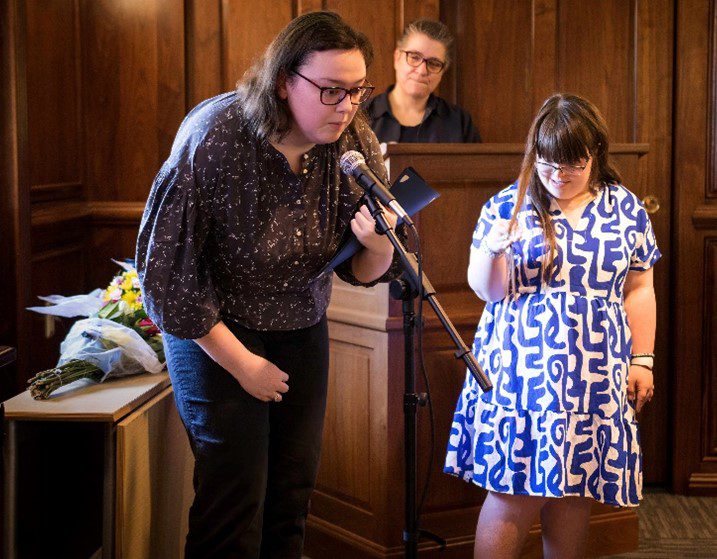
During this meeting, we will hear from a few graduates and students from the College and Career Studies program at the University of Kentucky about ways they are connecting with their community. Afterward, we would love to hear from everyone else about ways you connect with your community.
We hope you will join us for this conversation!
For more information about this group, or to get the zoom link for this meeting, please contact Erin Fitzgerald at Erin.Fitzgerald@uky.edu.
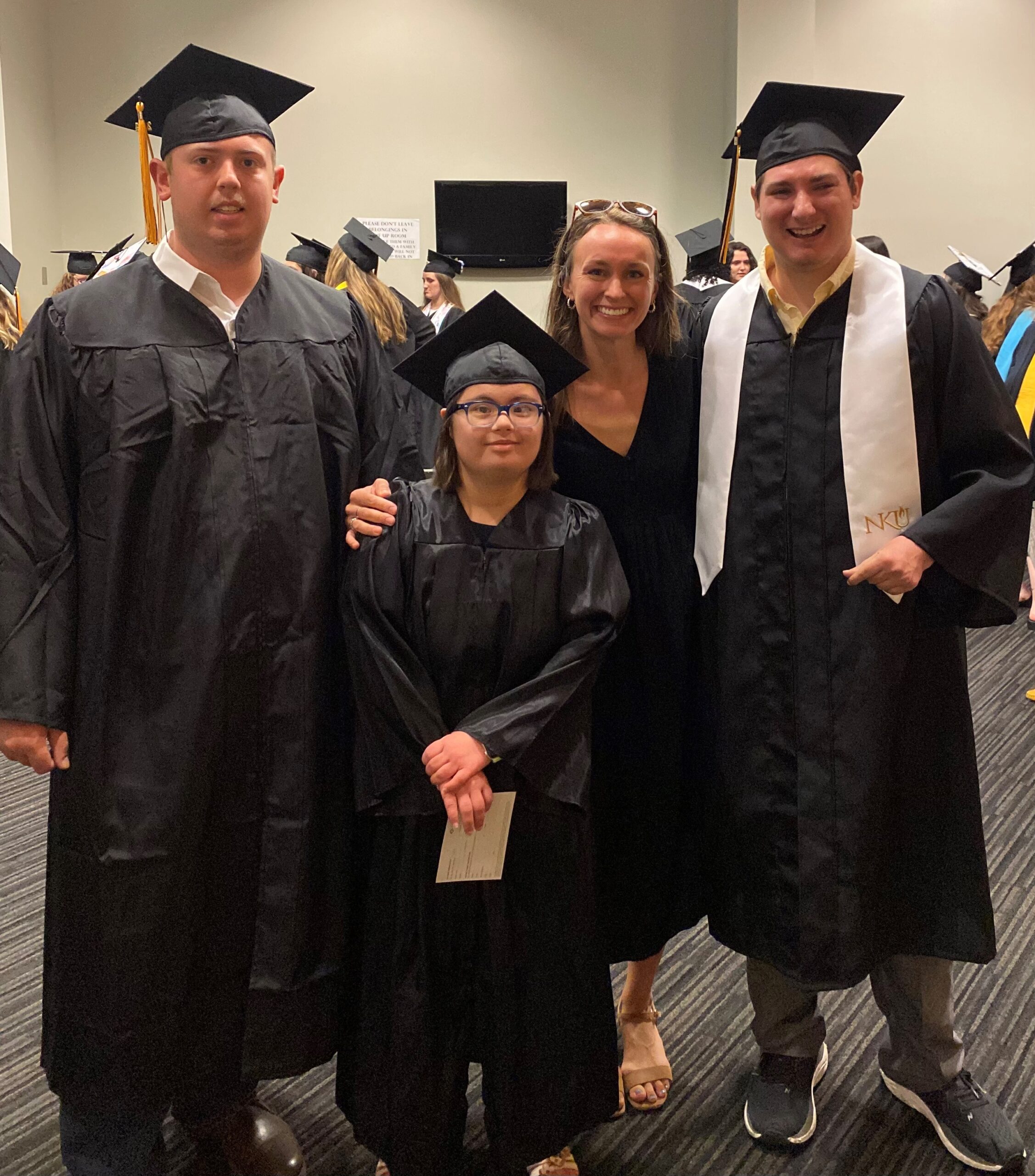
Two Students Celebrated at Northern Kentucky University Celebration
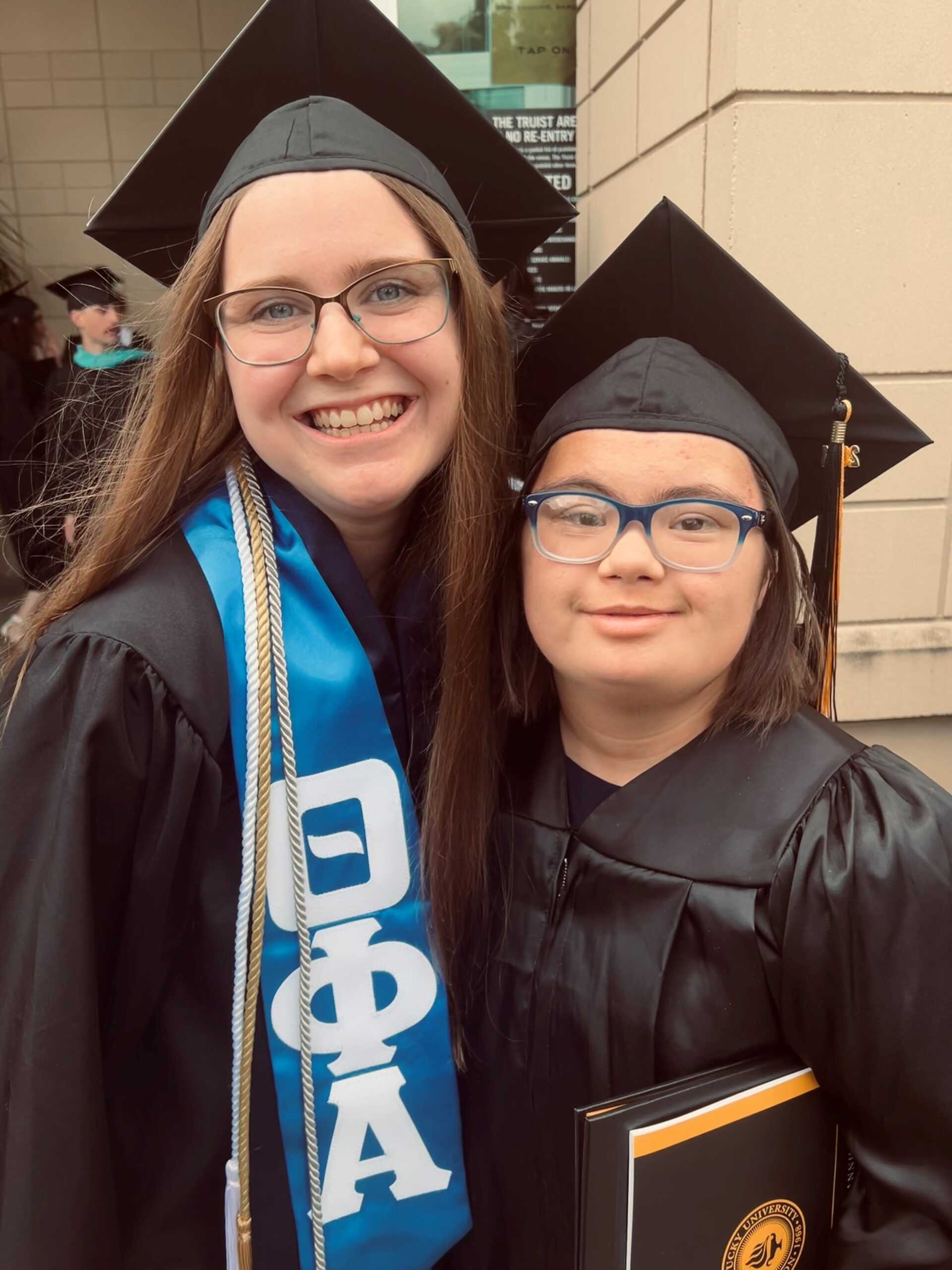
Two students complete the Supported Higher Education Program at Northern Kentucky University. Congratulations to Tara McGrath and Michael Bushman!
Tara has taken classes across multiple disciplines, including Education, Theatre, English, Business, and more.
In this picture is Tara (far right) and her peer mentor Kayla Rich during commencement.
She has completed on-campus internships at Empower Learn Create, Steely Library, Northerner, NKU Theatre Box Office and most recently the College of Education Office. Emily Hellman of NKU’s SHEP often hears feedback from Tara’s instructors, internship supervisors, and peer mentors about how delightful, hard-working, and dedicated she is. She has represented NKU and the SHEP Program by leading campus tours and meeting with prospective students and their families. It is not uncommon for Tara to go above and beyond in her work while exceeding expectations.
Michael has taken classes in Art, English, Communications, Dance and Theatre. He’s held a paid internship at the Steely Library for the last three years and has assumed a number of roles and responsibilities through this position.
Michael has achieved success not only as a valuable intern, but has continued to challenge and apply himself in the classroom setting as well. Michael was one of the first students in the SHEP Program to live on campus in the residence halls and Emily is grateful for the role that he played in making on-campus housing an inclusive and accessible opportunity for all students.
Cole Amann (pictured far right in the group photo) completed the SHEP Program in Spring of 2020. Due to COVID restrictions, all University events were canceled and he was never able to attend the commencement ceremony. His Mom reached out to me a few months ago asking if Cole could participate in the commencement ceremony with our other two graduates this spring! We enjoyed seeing Cole again and was glad that we he was able to join the celebration.
Gavin Basham and Amie Morris are trailblazers in the CLS Program.
Owensboro Community and Technical College (OCTC) graduated its first two students this spring from the Career and Life Skills certificate program: Gavin Basham and Amie Morris.
The Career and Life Skills certificate is designed to improve employment options through college-level coursework that includes life-long learning skills, digital literacy, and career exploration, as well as essential workplace skills through experiential learning opportunities for students with intellectual disabilities.
The program is a 2-year program that started at OCTC in the fall of 2022 with Gavin and Amie being the first participants in the program. There are now a total of 6 students in the CLS program.
Gavin Basham was interested in working in kitchens and restaurants. He gained much experience in food preparation and culinary arts. Through his CLS internships he was offered a job at one of his placements.
Amie Morris found real joy and vision in the art classes that she took over the semesters. The artwork she produced astonished everyone around her. Although she has completed the CLS certificate, she may continue enrolling in other art classes here at OCTC.